
- VOICE & DATA NETWORKS
We offer series unified communication systems that handles both voice such as conventional or ip Intercom Telephony and Data Traffic over a single infrastructure, typically using Voice over Internet Protocol (VoIP) technology to transmit calls as data packets, Our deployments are dependent on the peculiarities of your needs and projects with standardized applications.
This integration simplifies network management, reduces costs by eliminating separate phone lines, and offers increased flexibility and scalability for businesses by combining phone, video, and data
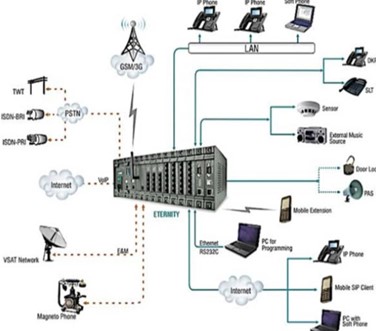
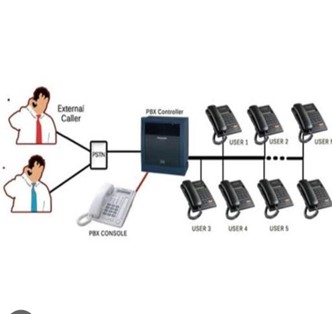
4.1 Intercom Telephony Network We provide PABX / iPBX, as stand-alone voice communication network for internal use within a building or group of buildings, enabling users to call and speak to one another without external lines frequency transceivers that also have data network connections and provide mobile connectivity to the data network. Systems can be wired or wireless and may include features like door control, integration with PA systems, and connection to public telephone networks. They are widely used in residential homes, offices, schools, and hotels to provide efficient internal communication and access control.
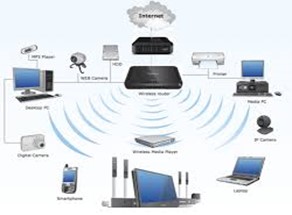
4.2 WILAN & WIMAX Connectivity; The standard connectivity is to enable devices like computers and smartphones to connect to a wireless local area network (WLAN) and the internet without physical cables, using radio waves based on the IEEE 802.11 standard. A wireless router broadcasts the signal, allowing enabled devices to access the internet and communicate with each other in a local area, providing high-speed data transfer over short distances.
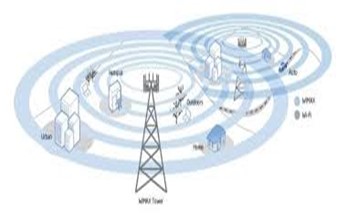
However, we have also built capacity using standard protocols to guarantee you WiMAX connectivity for Microwave Access, a wireless broadband technology that delivers high-speed internet access over large areas, similar to DSL or cable. It operates on a standard IEEE 802.16 protocol, providing service for both fixed locations and mobile devices across a metropolitan or even larger geographical area, with a range much greater than Wi-Fi
4.3 Structured Cabling
Unlike unstructured cabling, our structured cabling deliveries deploys organized and modular components to provide predictable frameworks for predictable performances, easy moves, adds, changes, and future scalability, all following industry standards like ANSI/TIA-568.


Recent Comments